

According to the Leading Learning Annual Survey 2026, 71.2% of learning businesses say AI is important, very important, or critical to their strategy this year. Yet only about a quarter are actually using it in their education offerings, and roughly half have no implementation plan at all.
Part of the problem is how AI gets prioritized. In the same survey, AI ranks fourth of eight strategic trends, behind workforce needs, learner flexibility, and personalized learning. But flexibility and personalization at scale are exactly what AI makes possible. AI isn't competing with those priorities. It's how you deliver them.
So what does that look like in practice? Here's what's working, what the data shows, and how to decide where your organization should invest.
Leading organizations are building AI into the learning experience
The most promising uses of AI aren't add-ons. They're built into how learners study and practice.
PMI launched PMI Infinity, an AI assistant grounded in PMI's standards that supports professionals in both learning and their day-to-day project work.
The American Management Association created Skill Coach, which uses AI role-play so seminar participants can practice realistic workplace conversations and get immediate, personalized feedback.
ACCA added an AI Assistant to its Study Hub, giving learners on-demand guidance and clarification as they work through course material.
The common thread is a shift from "here's content" to "here's help succeeding." Learners don't need more content. They need help turning content into competence.
What the data shows
BenchPrep's AI Assistant has now handled more than 1.1 million learner messages. When we compared learners who used it with those who didn't, at organizations that have offered it for three months or more, users showed:
- 12% higher course progress (89.5% vs. 79.8%)
- 9% more practice exams completed (12.7 vs. 11.7)
- 4% more time spent learning (78.1 vs. 74.8 hours)
- A 6.2-point higher NPS (74.7 vs. 68.5)
- Slightly higher scores on practice exams (68.7% vs. 67.4%) and practice questions (61.7% vs. 60.9%)
Learners chose whether to use the assistant, so these are correlations rather than proof of cause. Still, every measure points the same way: more engagement, higher satisfaction, and modestly better performance.
Customers are seeing the results too. "The feedback has been great from candidates," said a managing director at a financial services organization. "People are buying premium packages because of it. Overall, we saw a big drop in our faculty team support tickets over the summer."
A VP of Assessment and Digital Solutions at a healthcare organization pointed to the operational side: "For us, it is exciting to offer innovative, AI-driven support without adding to our operational overhead, all while knowing that our content and learner data are protected."
Learner questions show where content falls short
AI conversations also create something most organizations have never had: a record, in learners' own words, of where they get stuck. On BenchPrep's platform, learners most often ask for definitions, then help with practice questions, explanations, and comparisons between similar concepts.
A completion report tells you who finished. These conversations tell you what confused learners along the way, which shows you exactly what to build or revise next.
How to decide where to invest
Not every AI idea deserves funding. A simple test is to rate each one on two questions: Does it advance your mission? And does it deliver a financial return, in revenue or time saved?
- Novelty (low mission, low return): Impressive demos with no payoff, like a generic "AI for accountants" course that many providers already sell.
- Mission investment (high mission, low return): Worth doing but hard to fund, like AI support for non-native speakers or accessibility-adapted study tools.
- Efficiency (low mission, high return): AI that frees up staff time, like generating practice questions or interactive activities from existing content. For most organizations, this is the best place to start.
- Flywheel (high mission, high return): AI where better outcomes drive revenue, like an AI assistant offered as a premium tier. Better-prepared learners pass more, renew more, and buy more.
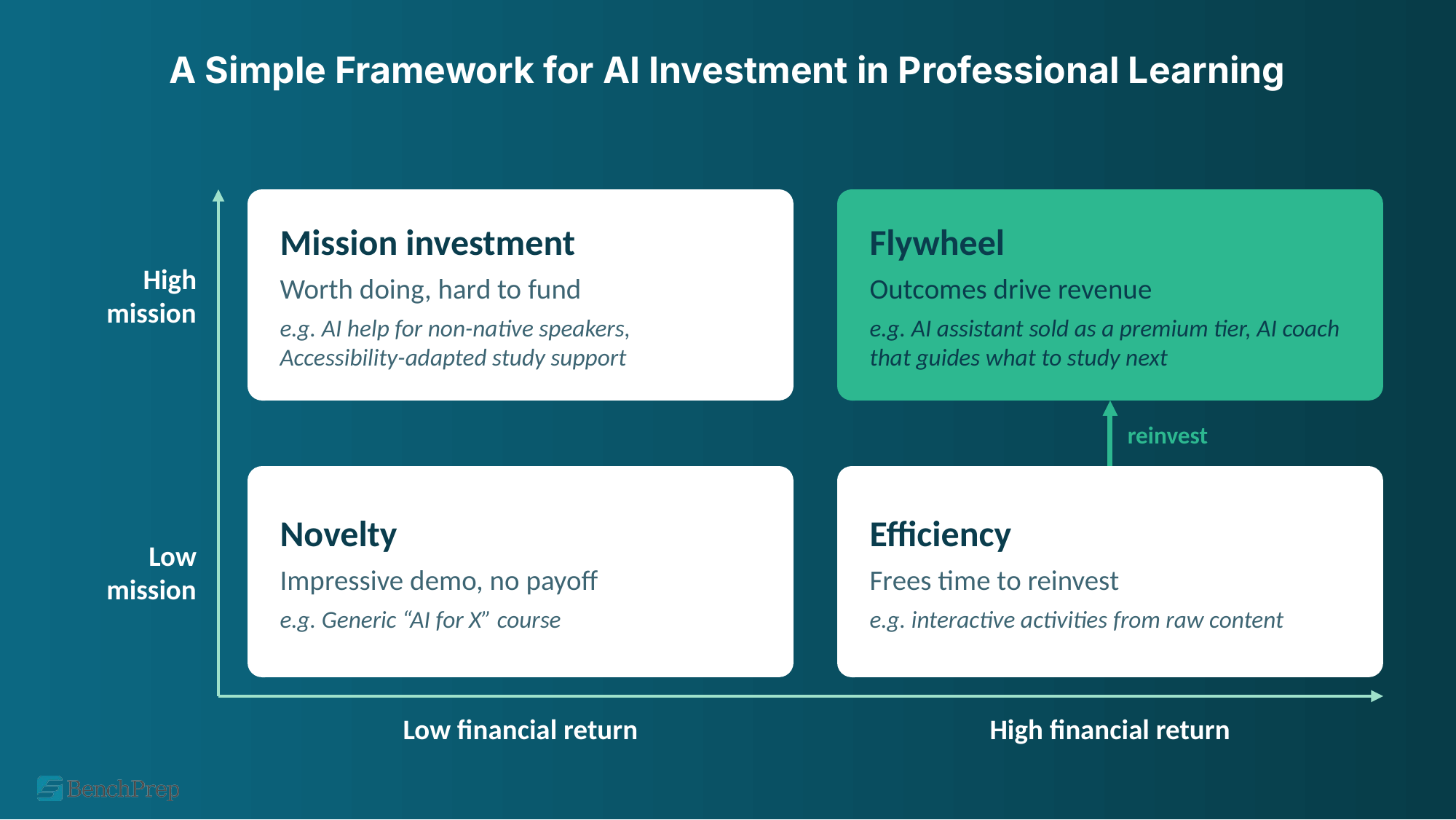
The key is what happens after efficiency. Many association learning teams are small, and AI can help them run bigger programs. But time saved and simply banked is just a cost cut. Reinvested in better content and learner support, it moves you into the flywheel, which in turn helps fund the mission investments that are hard to pay for on their own.
Where to start
Before committing to your next AI initiative, ask two questions: Which quadrant does it fall in? And if it saves time, where will that time go?
The organizations getting real results from AI aren't running the most pilots. They're the ones using it to lighten the load on their teams, and putting what it frees up back into their learners.
Ready to see how AI can support your learning programs? Schedule a demo.